Building a Custom Genetic Algorithm#
This notebook walks through the process of writing a custom genetic algorithm on top of sigmaepsilon.math.optimize, reusing as much of the library’s infrastructure as possible. BinaryGeneticAlgorithm, IntegerGeneticAlgorithm and RealValuedGeneticAlgorithm (all covered in the Optimization guide) are themselves nothing more than examples of exactly this process — small subclasses of GeneticAlgorithm that plug in a specific genotype representation. By the end of this notebook you’ll have written a fourth one from scratch, and understand precisely which parts of the framework you get for free and which parts are genuinely yours to design.
Why do we need a custom class here?#
The three built-in classes all assume the decision variables are independent: each one lives in its own box (ranges[d]), and crossover/mutation can touch one variable without affecting the validity of the others. That covers a huge range of problems, but not all of them.
As a running example, we’ll solve a small Traveling Salesman Problem (TSP): given a set of cities, find the shortest closed tour that visits every city exactly once. The natural representation for a candidate solution is a permutation of city indices — and permutations are exactly the case the box-independent assumption breaks down: if you mutate or crossover each position independently (the way BinaryGeneticAlgorithm/IntegerGeneticAlgorithm/RealValuedGeneticAlgorithm do), you’ll almost certainly end up with a city missing and another one repeated — not a valid tour at all. We need crossover and mutation operators that are aware of the permutation constraint, which means writing our own GeneticAlgorithm subclass.
The extension points, recapped#
GeneticAlgorithm is built as a template-method: the evolution loop itself (evolver/evolve/solve, elitism, champion tracking, stopping) is fixed, and a subclass plugs in the representation-specific pieces:
method |
role |
default in |
|---|---|---|
|
produce a pool of genotypes |
raises |
|
combine two parents into two offspring |
raises |
|
perturb one genotype |
raises |
|
genotype ↔ phenotype |
identity — override only if they differ |
|
pick the survivors of a generation |
pluggable, backed by |
|
decide when to stop early |
“champion age exceeds |
For our permutation GA, populate/crossover/mutate are genuinely new (that’s the whole point), while encode/decode/select/stopping_criteria — plus a good deal of bookkeeping in __init__ (population-size validation, elitism, the per-instance rng, selection_strategy, vectorized/n_jobs evaluation) — can be reused as-is.
Imports#
import numpy as np
import matplotlib.pyplot as plt

from sigmaepsilon.math.optimize.ga import GeneticAlgorithm
from sigmaepsilon.math.optimize import RankSelection
Step 0 — Define the problem#
A handful of randomly placed cities, and the objective function: the total length of the closed tour that visits them in the order given by order (an array of city indices).
city_rng = np.random.default_rng(42)
n_cities = 15
coords = city_rng.uniform(0, 100, size=(n_cities, 2))


def tour_length(order):
    order = np.asarray(order, dtype=int)
    points = coords[order]
    points_next = np.roll(points, -1, axis=0)
    return np.sum(np.linalg.norm(points - points_next, axis=1))
plt.figure(figsize=(4, 4))
plt.scatter(coords[:, 0], coords[:, 1])
for i, (x, y) in enumerate(coords):
    plt.annotate(str(i), (x, y))
plt.title(f"{n_cities} cities to visit")
plt.show()
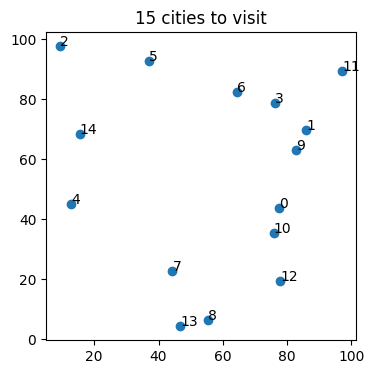
We’ll minimize tour_length, so every GA instance below is constructed with minimize=True.
Step 1 — Subclass GeneticAlgorithm and adapt __init__#
GeneticAlgorithm’s constructor takes (fnc, ranges, *, ...), and uses ranges for two things: deriving self.dim (self.ranges.shape[0], unless fnc has a .dimension attribute) and — in the built-in subclasses — scaling decoded values into a box. Our permutation problem has neither continuous ranges nor independent variables, but we still want self.dim to come out as the number of cities, so we accept n_cities directly and synthesize a placeholder ranges purely to get self.dim right; nothing in our GA will actually read the bounds inside it. Everything else — nPop, elitism, seed, selection_strategy, vectorized, n_jobs, … — is simply forwarded to GeneticAlgorithm’s __init__ via **kwargs, unchanged.
class PermutationGeneticAlgorithm(GeneticAlgorithm):
    __slots__ = ()

    def __init__(self, fnc, n_cities, **kwargs):
        placeholder_ranges = [[0, n_cities - 1]] * n_cities
        super().__init__(fnc, placeholder_ranges, **kwargs)
Before we implement populate/crossover/mutate, let’s confirm the base class’s contract really is enforced: constructing an instance calls reset(), which eagerly calls populate() to build the first generation, so instantiating now should fail loudly rather than silently doing nothing:
try:
    PermutationGeneticAlgorithm(tour_length, n_cities, nPop=8)
except NotImplementedError as e:
    print("Fails as expected:", e)
Fails as expected: PermutationGeneticAlgorithm does not implement 'populate'.
Step 2 — populate#
populate(genotypes=None) has two responsibilities, following the same pattern as BinaryGeneticAlgorithm/RealValuedGeneticAlgorithm:
if
genotypes is None(the very first generation), createnPop / 2random genotypes — here, random permutations ofrange(n_cities)viaself.rng.permutation;otherwise,
genotypesare thenPop / 2survivors returned byselect(), and we need to breed them back up to a full population ofnPopviarandom_parents_generator(inherited, unchanged) and our owncrossover.
One subtlety worth calling out explicitly: GeneticAlgorithm’s select (which we are about to reuse unmodified) always returns dtype=float, since it was written with continuous phenotypes in mind. Our genotypes must stay integer city indices, so populate casts back to int right at the top.
def populate(self, genotypes=None):
    nPop = self.nPop

    if genotypes is None:
        genotypes = np.array(
            [self.rng.permutation(self.dim) for _ in range(int(nPop / 2))]
        )
    else:
        genotypes = np.asarray(genotypes, dtype=int)

    nParent = genotypes.shape[0]

    if nParent < nPop:
        offspring = []
        parent_pairs = self.random_parents_generator(genotypes)
        while (len(offspring) + nParent) < nPop:
            parent1, parent2 = next(parent_pairs)
            offspring.extend(self.crossover(parent1, parent2))
        genotypes = np.vstack([genotypes, offspring])

    return genotypes


PermutationGeneticAlgorithm.populate = populate
Step 3 — crossover#
Naive crossover (e.g. cutting both parents at the same point and swapping halves, like BinaryGeneticAlgorithm does) would produce invalid tours: a city could appear twice in the child and another not at all. We need an operator that’s aware of the permutation constraint — the classic choice is order crossover (OX):
pick two random cut points and copy the slice between them from parent 1 into the child, unchanged;
fill the remaining positions, in the order they appear in parent 2, skipping any city that’s already in the copied slice.
This guarantees the child is a valid permutation, while still inheriting structure from both parents. We build both children (swapping the parents’ roles) and immediately hand each one to mutate — mirroring exactly the shape of BinaryGeneticAlgorithm’s crossover.
def crossover(self, parent1, parent2):
    n = self.dim

    if self.rng.random() > self.p_c:
        return parent1.copy(), parent2.copy()

    i, j = sorted(self.rng.choice(n, size=2, replace=False))

    def order_crossover(donor, filler):
        child = -np.ones(n, dtype=int)
        child[i:j] = donor[i:j]
        remaining = [city for city in filler if city not in child[i:j]]
        child[child == -1] = remaining
        return child

    child1 = order_crossover(parent1, parent2)
    child2 = order_crossover(parent2, parent1)
    return self.mutate(child1), self.mutate(child2)


PermutationGeneticAlgorithm.crossover = crossover
Step 4 — mutate#
Similarly, mutating by flipping bits (as BinaryGeneticAlgorithm does) makes no sense for a permutation. The standard choice is swap mutation: with probability p_m, pick two positions and swap their cities. That’s it — the result is trivially still a valid permutation.
def mutate(self, child):
    if self.rng.random() < self.p_m:
        child = child.copy()
        i, j = self.rng.choice(self.dim, size=2, replace=False)
        child[i], child[j] = child[j], child[i]
    return child


PermutationGeneticAlgorithm.mutate = mutate
With mutate in place too, we can finally instantiate the class (recall it failed above) and sanity-check crossover/mutate together, on two small, human-readable permutations, before trusting them inside a full GA run:
toy_ga = PermutationGeneticAlgorithm(lambda order: 0.0, 8, nPop=8, seed=0)
toy_parent1 = np.array([0, 1, 2, 3, 4, 5, 6, 7])
toy_parent2 = np.array([3, 7, 5, 1, 6, 0, 2, 4])

toy_child1, toy_child2 = toy_ga.crossover(toy_parent1, toy_parent2)
print("parent 1:", toy_parent1)
print("parent 2:", toy_parent2)
print("child 1: ", toy_child1)
print("child 2: ", toy_child2)
print("both children are valid permutations:", set(toy_child1) == set(toy_child2) == set(range(8)))
parent 1: [0 1 2 3 4 5 6 7]
parent 2: [3 7 5 1 6 0 2 4]
child 1:  [7 1 2 3 4 5 6 0]
child 2:  [2 7 5 1 6 0 3 4]
both children are valid permutations: True
What we didn’t have to write#
With populate/crossover/mutate in place, the class is fully functional — everything else is inherited from GeneticAlgorithm untouched:
assert PermutationGeneticAlgorithm.encode is GeneticAlgorithm.encode
assert PermutationGeneticAlgorithm.decode is GeneticAlgorithm.decode
assert PermutationGeneticAlgorithm.select is GeneticAlgorithm.select
assert PermutationGeneticAlgorithm.divide is GeneticAlgorithm.divide
assert PermutationGeneticAlgorithm.stopping_criteria is GeneticAlgorithm.stopping_criteria
assert PermutationGeneticAlgorithm.random_parents_generator is GeneticAlgorithm.random_parents_generator
print("encode/decode/select/divide/stopping_criteria/random_parents_generator: all reused as-is")
encode/decode/select/divide/stopping_criteria/random_parents_generator: all reused as-is
encode/decode default to the identity mapping, which is exactly right here: our genotype (a permutation of city indices) already is the phenotype, the same way it is for RealValuedGeneticAlgorithm. select already comes with a working, pluggable implementation backed by selection_strategy (default TournamentSelection) — we’ll make use of that pluggability further down. stopping_criteria’s default (stop once the champion hasn’t improved for maxage generations) is a perfectly sensible rule for a TSP tour too.
Solving the problem#
Everything is in place — let’s run it.
ga = PermutationGeneticAlgorithm(
    tour_length, n_cities, nPop=60, minimize=True, maxage=30, seed=0
)

fitness_history = []
diversity_history = []
for _ in range(120):
    ga.evolve(1)
    fitness_history.append(ga.champion.fitness)
    diversity_history.append(ga.diversity)

champion_order = np.asarray(ga.champion.phenotype, dtype=int)
print("best tour found:", champion_order)
print("tour length:", ga.champion.fitness)
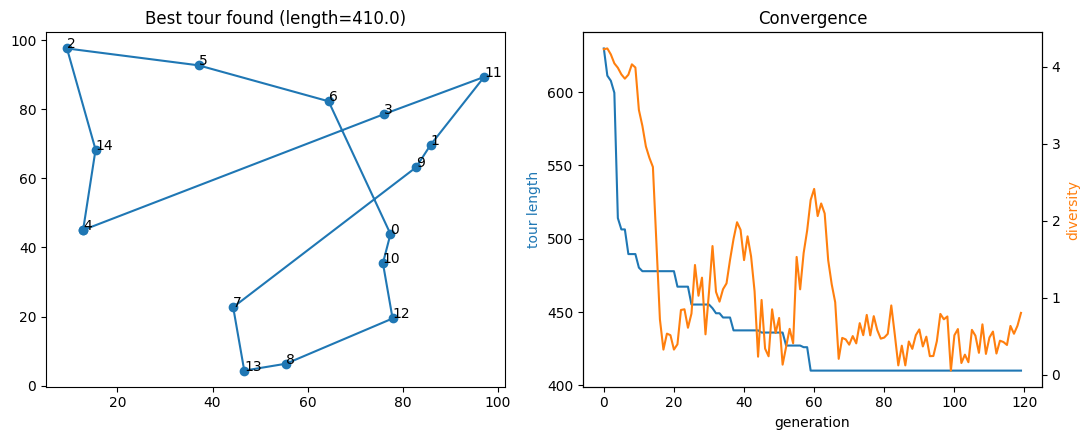
best tour found: [ 4 14  2  5  6  0 10 12  8 13  7  9  1 11  3]
tour length: 410.03967346322673
For context, let’s compare against the best of 2000 purely random tours:
random_lengths = [tour_length(city_rng.permutation(n_cities)) for _ in range(2000)]
print("best of 2000 random tours:", min(random_lengths))
print("GA champion:              ", ga.champion.fitness)
best of 2000 random tours: 551.051547282789
GA champion:               410.03967346322673
And visualize both the resulting tour and the convergence history — including the inherited diversity property, which works out of the box because it’s computed generically from self.phenotypes (the per-dimension standard deviation across the population). It’s not the most natural diversity measure for permutations, but it’s still informative: a value near zero means the population has collapsed onto very similar orderings.
tour_points = coords[np.append(champion_order, champion_order[0])]

fig, axes = plt.subplots(1, 2, figsize=(11, 4.5))

axes[0].plot(tour_points[:, 0], tour_points[:, 1], "o-")
for i, (x, y) in enumerate(coords):
    axes[0].annotate(str(i), (x, y))
axes[0].set_title(f"Best tour found (length={ga.champion.fitness:.1f})")

axes[1].plot(fitness_history, color="tab:blue")
axes[1].set_xlabel("generation")
axes[1].set_ylabel("tour length", color="tab:blue")
ax2 = axes[1].twinx()
ax2.plot(diversity_history, color="tab:orange")
ax2.set_ylabel("diversity", color="tab:orange")
axes[1].set_title("Convergence")

plt.tight_layout()
plt.show()
Reusing the library’s pluggability#
Because select was left untouched, our brand-new GA already supports every SelectionStrategy the library ships with — no extra code required. Let’s rerun with RankSelection instead of the default TournamentSelection:
ga_rank = PermutationGeneticAlgorithm(
    tour_length,
    n_cities,
    nPop=60,
    minimize=True,
    maxage=30,
    seed=0,
    selection_strategy=RankSelection(),
)
champion_rank = ga_rank.solve()
print("TournamentSelection (default):", ga.champion.fitness)
print("RankSelection:                ", champion_rank.fitness)
TournamentSelection (default): 410.03967346322673
RankSelection:                 419.6873865767511
Reproducibility comes for free too, via the same seed argument every other GA class in the library accepts:
ga_a = PermutationGeneticAlgorithm(tour_length, n_cities, nPop=60, minimize=True, maxage=30, seed=7)
ga_b = PermutationGeneticAlgorithm(tour_length, n_cities, nPop=60, minimize=True, maxage=30, seed=7)
result_a = ga_a.solve()
result_b = ga_b.solve()
result_a.phenotype == result_b.phenotype
True
Bonus: overriding a property — a permutation-aware diversity metric#
The inherited diversity property (per-dimension standard deviation of the phenotypes) treats city indices as if they were numbers on a continuous scale, which isn’t quite the right notion of “spread” for permutations. Since diversity is a regular property, we can override it just as easily as any method — here with the average, over all pairs of individuals, of the fraction of positions at which they disagree:
def diversity(self) -> float:
    genotypes = np.asarray(self.genotypes)
    disagreement = (genotypes[:, None, :] != genotypes[None, :, :]).mean(axis=2)
    i, j = np.triu_indices(len(genotypes), k=1)
    return float(disagreement[i, j].mean())


PermutationGeneticAlgorithm.diversity = property(diversity)

ga_custom_diversity = PermutationGeneticAlgorithm(
    tour_length, n_cities, nPop=60, minimize=True, maxage=30, seed=0
)
ga_custom_diversity.evolve(5)
ga_custom_diversity.diversity
0.8228625235404896
Recap#
Starting from GeneticAlgorithm, a working, reproducible, pluggable-selection genetic algorithm for a genuinely different genotype representation (permutations, not independent boxed variables) took:
a thin
__init__override to adapt the constructor’s shape to the problem at hand;populate,crossover(order crossover) andmutate(swap mutation) — the three methods with no meaningful generic default, exactly as the base class’s docstring says;optionally, a
diversityoverride for a representation-specific notion of population spread.
Everything else — population-size validation, elitism, the per-instance rng (and therefore seed-based reproducibility), selection_strategy (and therefore TournamentSelection/RouletteSelection/RankSelection for free), vectorized/n_jobs evaluation, champion tracking, stopping_criteria, and the whole evolver/evolve/solve loop — came from GeneticAlgorithm unmodified. This is exactly the same recipe BinaryGeneticAlgorithm, IntegerGeneticAlgorithm and RealValuedGeneticAlgorithm follow internally; see their source (sigmaepsilon/math/optimize/{bga,iga,rga}.py) for two more worked examples of the same pattern.